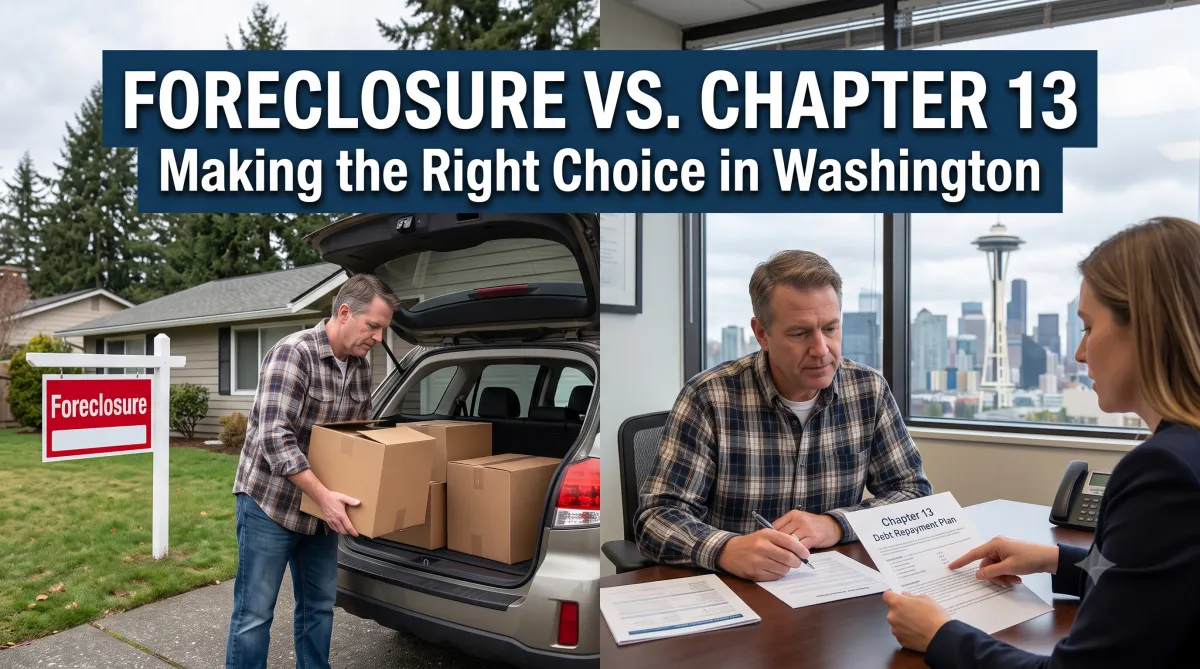
Foreclosure vs Chapter 13 in Washington
Foreclosure vs Chapter 13 is a critical choice for Washington homeowners who are behind on mortgage payments.
A strategic default may feel like taking control. In reality, it often gives control to the lender, trustee, auction process, and housing market. Chapter 13 can offer a structured reorganization. It may stop foreclosure, spread mortgage arrears over time, and let the homeowner keep the property if the plan works.
Key Takeaways
• Chapter 13 may stop foreclosure if filed before the trustee sale.
• Washington foreclosure deadlines move fast once notices are issued.
• Strategic default gives up leverage unless there is a clear exit plan.
What Is Strategic Default in Washington Foreclosure?
Strategic default means choosing to stop mortgage payments even when the homeowner might still have some ability to pay.
Some borrowers consider it when the home feels unaffordable, the loan balance is high, or the property no longer fits the household budget. Others use the phrase more loosely when they feel forced to stop paying because the numbers no longer work.
Either way, default starts a chain reaction.
In Washington, many home loans are secured by deeds of trust. Those can often be foreclosed through a nonjudicial trustee sale. That means the lender may not need to file a full lawsuit before moving toward sale (RCW 61.24 – Deeds of Trust).
The process usually includes notices, deadlines, possible mediation rights, and a scheduled sale date (RCW 61.24.030 – Notice of Default; RCW 61.24.040 – Notice of Trustee’s Sale).
The danger is control.
Once default begins, the lender and trustee drive the timeline. The homeowner may still have options, but those options shrink as the sale date gets closer.
Strategic default may also affect:
• Credit
• Housing stability
• Future borrowing
• Relocation timing
• Deficiency risk in some cases
• Tax issues
• HOA or condo dues
• Second mortgages
• Family stress
Default is not always wrong. Sometimes keeping the home is not realistic.
But default without a plan can turn a financial problem into a housing emergency.
How Does Chapter 13 Stop Foreclosure?
Chapter 13 can stop foreclosure through the automatic stay.
When a homeowner files Chapter 13 before the foreclosure sale, the automatic stay usually stops the foreclosure from moving forward. The homeowner then proposes a repayment plan.
That plan may allow the borrower to cure mortgage arrears over 3 to 5 years while making ongoing mortgage payments (U.S. Courts – Chapter 13 Bankruptcy Basics).
This is the key difference.
Strategic default lets the arrears grow until the trustee sale happens or another workout succeeds. Chapter 13 creates a court-supervised structure for catching up.
A Chapter 13 plan may address:
• Missed mortgage payments
• Late fees
• Trustee fees
• Escrow shortages
• Property taxes
• Priority tax debt
• Car loans
• Credit cards
• Medical bills
• Personal loans
• Judgment debts
The plan must be feasible.
That means the homeowner needs enough income to make ongoing mortgage payments and Chapter 13 plan payments. If the home is still unaffordable after filing, Chapter 13 may only delay the loss.
But if the problem is temporary arrears, Chapter 13 can be powerful.
It can turn one impossible lump sum into a structured repayment plan.
The foreclosure problem is usually not one missed payment. It is the demand to catch up everything at once.
Why Is Chapter 13 Often Better Than Letting the Home Go?
Chapter 13 is often better when the homeowner wants to keep the home and the budget can support it going forward.
Foreclosure is final once the trustee sale is completed. Waiting too long can eliminate the chance to reorganize around the property.
Chapter 13 may help because it can:
• Stop a scheduled trustee sale
• Spread arrears over time
• Protect home equity
• Stop collection lawsuits
• Stop wage garnishment
• Manage car loans and tax debts
• Reduce unsecured debt pressure
• Create one court-supervised plan
• Give the homeowner a deadline-based path
Strategic default may feel simpler at first.
You stop paying. Cash flow improves for a few months. The pressure pauses.
Then the notices arrive. Fees increase. The sale date gets recorded. The homeowner must decide whether to reinstate, sell, modify, file bankruptcy, or move.
By then, options may be narrower.
Chapter 13 does not guarantee success. Missed post-filing mortgage payments can put the home at risk again. Missed plan payments can lead to dismissal.
But Chapter 13 gives a homeowner a legal framework.
Strategic default depends on hope, delay, and lender behavior.
Reorganization works best when the homeowner still has income, time, and a realistic payment path.
What Washington Foreclosure Deadlines Should Homeowners Know?
Washington foreclosure deadlines matter because delay can destroy options.
A Notice of Default is one major warning. If nothing changes, a Notice of Trustee’s Sale may follow. That notice sets the auction date.
Washington notices warn homeowners not to delay because a notice of sale may be issued as soon as 30 days after the Notice of Default. The Notice of Trustee’s Sale must provide at least 120 days’ notice of the actual foreclosure sale (RCW 61.24.030 – Notice of Default; RCW 61.24.040 – Notice of Trustee’s Sale).
Mediation rights can also expire.
Eligible homeowners may request foreclosure mediation after receiving a Notice of Default. The referral must usually happen no later than 90 calendar days before the sale date listed in the Notice of Trustee’s Sale. Homeowners cannot self-refer. A housing counselor or attorney must refer them (Washington State Department of Commerce – Foreclosure Fairness Program).
Washington law also gives borrowers a right to cure the default before sale.
In many cases, the borrower may stop the sale by curing the default before the 11th day before the scheduled sale. That means paying the missed amounts, required fees, trustee costs, and other amounts allowed by law (RCW 61.24.090 – Curing Defaults Before Sale).
These deadlines show why last-minute action is risky.
If the trustee sale already happened, Chapter 13 may not save the home. Bankruptcy works best before the sale is completed.
If you received a Notice of Default or Notice of Trustee’s Sale, use the firm’s Contact page to discuss the timing immediately.
What Are the Risks of Strategic Default?
Strategic default creates risk because it depends on events outside your control.
The lender may move faster than expected. The trustee may record the sale notice. A buyer may purchase the property at auction. Credit damage may last for years. Moving costs may arrive before a new housing plan is ready.
Risks may include:
• Trustee sale
• Loss of home equity
• Credit damage
• Higher fees and arrears
• Missed mediation deadline
• Missed cure deadline
• Loss of negotiating leverage
• Trouble renting later
• HOA or condo collections
• Tax questions
• Second mortgage issues
• Emotional stress and family disruption
Washington generally restricts deficiency judgments after a nonjudicial trustee’s sale for obligations secured by the deed of trust, except in specific situations (RCW 61.24.100 – Deficiency Judgments). But that does not make default harmless.
There may be other debts outside the first mortgage.
A second mortgage, HOA dues, taxes, business guaranty, or commercial loan can create separate issues. A strategic default plan should identify every debt tied to the property before payments stop.
Default can make sense when selling, surrendering, or moving is the best financial decision.
But that should be a plan, not a drift.
The risk of strategic default is not only losing the home. It is losing the chance to choose how the home problem ends.
When Is Chapter 13 Not the Best Option?
Chapter 13 is not always the best option.
It may not fit if the homeowner cannot afford ongoing mortgage payments after filing. It may also fail if income is unstable, the arrears are too high, or the property is worth far less than the debt and no longer serves the household.
Chapter 13 may be less helpful when:
• The home is unaffordable long-term.
• Income is not stable.
• The foreclosure sale already happened.
• The homeowner wants to relocate.
• Property taxes are too high.
• Repairs are unaffordable.
• The plan payment would fail.
• A sale or surrender is the better path.
In those cases, other options may include selling the home, negotiating a loan modification, requesting mediation, surrendering the property, filing Chapter 7, or planning a controlled exit.
The best option depends on goals.
If the goal is to keep the home, Chapter 13 may help.
If the goal is to leave without chaos, bankruptcy may still help manage other debts.
If the goal is to preserve credit at all costs, waiting may backfire if foreclosure moves forward anyway.
A homeowner should compare every option before the trustee sale date gets too close.
Frequently Asked Questions
Q: Can Chapter 13 stop foreclosure in Washington?
A: Yes, Chapter 13 can often stop foreclosure if the case is filed before the foreclosure sale. The automatic stay usually stops the sale, and the Chapter 13 plan may allow the homeowner to catch up missed mortgage payments over time. The homeowner must keep making ongoing mortgage payments after filing.
Q: Is strategic default a good idea in Seattle?
A: Strategic default may make sense only when the homeowner has a clear exit plan and understands the consequences. It can damage credit, trigger foreclosure fees, reduce negotiating leverage, and lead to a trustee sale. If you want to keep the home, Chapter 13, mediation, or loan modification may be better options.
Q: How long do I have before a Washington foreclosure sale?
A: Washington foreclosure timing depends on the notices issued and the loan facts. A Notice of Trustee’s Sale generally provides at least 120 days’ notice before the sale. Some mediation rights must be exercised much earlier. If you received a Notice of Default or Notice of Trustee’s Sale, act immediately.
Q: What if I cannot afford the mortgage even after Chapter 13?
A: If you cannot afford ongoing mortgage payments after Chapter 13 begins, reorganization may not save the home. Chapter 13 works best when the arrears are the problem, not the future payment. A lawyer can help compare Chapter 13, Chapter 7, sale, surrender, mediation, or loan modification.
Ready to Stop Foreclosure Before the Sale Date?
A strategic default gives the lender the timeline. Chapter 13 may give you a reorganization plan.
If you live in Seattle or elsewhere in Washington and received foreclosure notices, do not wait until the trustee sale is days away.
The Law Firm of Howard Williams can help you review Chapter 13, foreclosure defense timing, mediation options, and debt-relief strategies.
Contact the Law Firm of Howard Williams today to discuss your next step.
About Howard Williams
Attorney Howard Williams is a Washington-based bankruptcy attorney and founder of the Law Firm of Howard Williams. He helps clients in Seattle, King County, and across Washington evaluate Chapter 7, Chapter 13, exemptions, creditor pressure, and debt-relief options.
