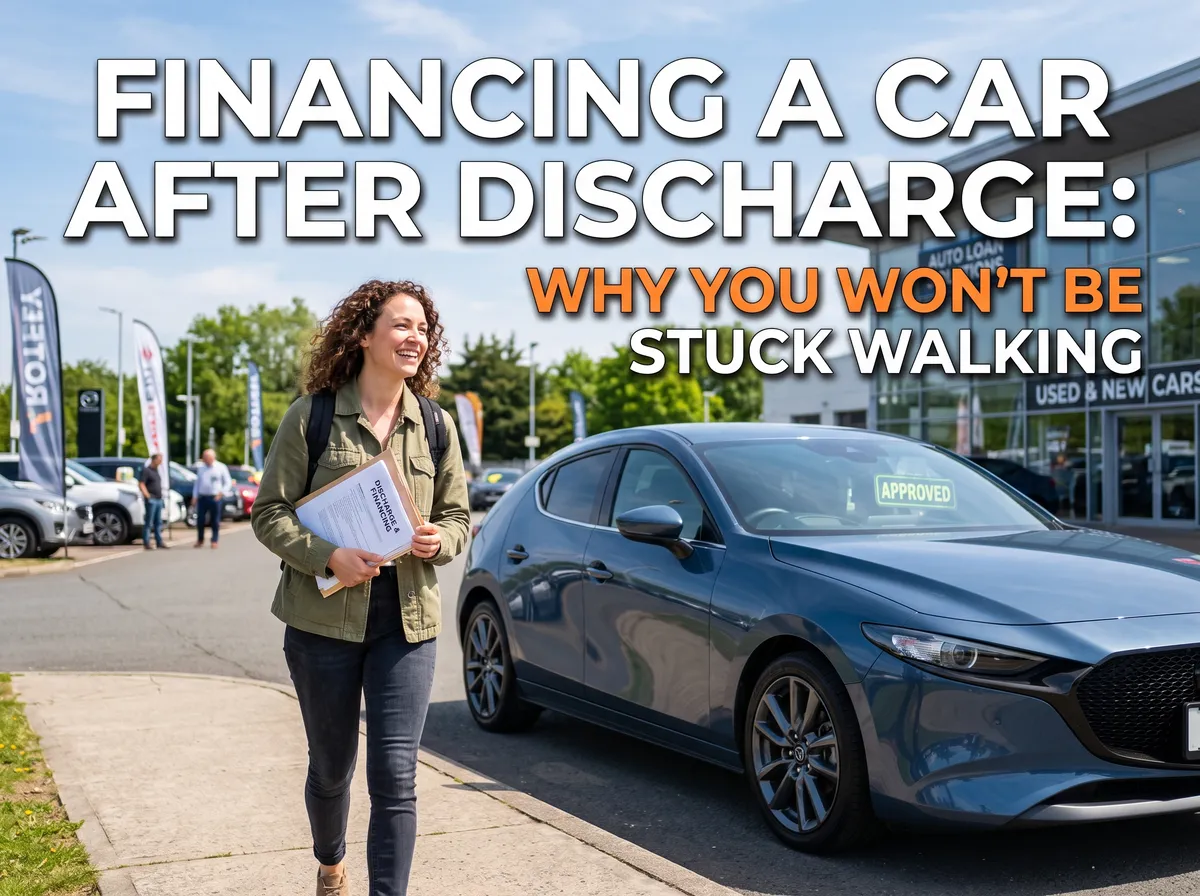
Financing a Car After Discharge: Why You Won't Be Stuck Walking
Car financing after Chapter 7 discharge is possible, even while the bankruptcy still appears on your credit report.
A discharge does not permanently remove you from the credit market. Approval, interest rate, down payment, income, and vehicle price still matter. The goal is not simply getting approved. It is getting transportation without immediately creating another unaffordable debt.
Key Takeaways:
• Chapter 7 does not permanently prevent you from financing another vehicle.
• Lenders consider more than the bankruptcy itself, including income, debts, credit, and down payment.
• Getting approved is only useful if the new loan fits your post-bankruptcy budget.
Can You Finance a Car After a Chapter 7 Discharge?
Yes. A Chapter 7 discharge does not mean you must wait until bankruptcy disappears from your credit report before seeking transportation financing.
A discharge releases an individual debtor from personal liability for many qualifying debts and prevents creditors from continuing collection on those discharged obligations.
That can create a different financial picture after bankruptcy.
Before filing, you may have been carrying:
• Credit-card minimum payments
• Medical debt
• Personal loans
• Collection accounts
• Judgment payments
• Other unsecured obligations
After discharge, many qualifying unsecured obligations may no longer require payment.
That does not instantly create good credit.
Chapter 7 can remain on a credit report for up to 10 years. However, the CFPB also notes that recent negative information generally has more impact on credit scores than older information.
In other words, bankruptcy appearing on your report does not mean your financial profile remains frozen for a decade.
What you do afterward matters.
Making new obligations on time, keeping balances controlled, and avoiding another debt cycle can help establish a stronger post-bankruptcy history.
For someone who needs a vehicle to commute from Renton, Kent, Shoreline, Federal Way, or another Seattle-area community, transportation may not be optional.
The question becomes:
What vehicle can you realistically afford now?
Not:
What is the most expensive vehicle someone will approve?
If concerns about losing access to transportation are stopping you from exploring bankruptcy, review your Seattle Chapter 7 options before assuming filing means years without a car.
A Chapter 7 discharge can end old debt. The next goal is making sure your first major new loan does not recreate the same financial pressure.
What Will Auto Lenders Look at After Bankruptcy?
Lenders evaluate the entire loan application, not only the word “bankruptcy.”
The CFPB identifies several factors lenders may consider when setting an auto-loan interest rate, including:
• Credit score
• Credit history
• Income
• Existing debts
• Down payment
The vehicle and amount financed can also affect the lender's risk.
A larger down payment reduces how much you need to borrow.
A less expensive vehicle can reduce both the payment and total interest.
Stable income can help demonstrate that the new payment fits your current budget.
The CFPB confirms that lenders use credit, income, debts, and down payment when deciding what auto-loan terms to offer.
This explains why two people with Chapter 7 bankruptcies may receive different offers.
One borrower may have:
• Stable employment
• $4,500 monthly income
• Few remaining debts
• $4,000 available for a down payment
Another may have:
• Unstable income
• Significant nondischargeable debt
• No down payment
• Recent missed payments after discharge
The bankruptcy may be similar.
The lending risk is not.
Before shopping, build a realistic transportation budget.
Include:
• Car payment
• Insurance
• Fuel
• Maintenance
• Registration
• Parking
• Expected repairs
A $450 payment is not really a $450 transportation cost.
If insurance, fuel, and parking add another $500 each month, the actual impact on your budget approaches $950.
Use the same income and expense discipline that helped determine whether Chapter 7 made sense.
How Can You Avoid a Bad Car Loan After Chapter 7?
Do not confuse an approval with a good deal.
Post-bankruptcy borrowers can be vulnerable to expensive financing because they may believe they have no negotiating power.
That assumption can cost thousands.
Start by comparing financing before choosing the vehicle.
Consider:
• Banks
• Credit unions
• Finance companies
• Dealer-arranged financing
Do not automatically accept the first dealer offer.
The CFPB states that dealer interest rates are negotiable and that dealers may not initially offer the lowest rate for which a buyer qualifies. It recommends comparing multiple lenders.
Compare APR, not only the monthly payment.
Also compare:
• Amount financed
• Loan term
• Total payments
• Down payment
• Finance charges
• Optional products
• Dealer fees
A dealership may make an expensive loan look affordable by stretching repayment across more months.
For example:
A 72-month loan can have a smaller payment than a 48-month loan.
But smaller does not mean cheaper.
A longer loan usually means paying interest for longer and can increase the risk that you owe more than the vehicle is worth.
The CFPB specifically warns that longer loan terms may reduce monthly payments while increasing total interest costs.
Also watch optional add-ons.
Examples include:
• Extended warranties
• Service contracts
• GAP products
• Tire protection
• Appearance packages
• Other dealer products
Some products may make sense in specific situations.
But financing them means paying interest on those products too.
Ask for the price of the vehicle, the loan, and every add-on separately.
Your first car after bankruptcy should rebuild mobility and financial stability—not prove how much debt you can qualify for again.
Should You Buy a Car Immediately After Discharge or Wait?
There is no single answer for every Chapter 7 debtor.
If your current vehicle works reliably, waiting may allow you to save a larger down payment and establish additional positive credit history.
That can put you in a stronger negotiating position.
If your vehicle failed and you need transportation for work, waiting may not be realistic.
In that situation, focus on affordability.
Buying sooner may make sense when:
• You cannot reliably get to work without a vehicle
• Your current car requires repairs worth more than keeping it
• You have stable income after bankruptcy
• You can afford insurance and maintenance
• You have found financing that fits your budget
Waiting may make sense when:
• Your existing car still works
• The available rates are extremely expensive
• You have no emergency savings
• You can build a larger down payment
• The proposed payment would leave almost no monthly cushion
Do not use your discharge as permission to immediately finance the maximum vehicle available.
Your first post-bankruptcy goal should be rebuilding financial margin.
If you have $800 left each month after normal living expenses, a $700 car payment leaves almost no room for repairs, medical expenses, or reduced work hours.
A smaller vehicle payment may provide more financial freedom than a newer vehicle.
Chapter 7 is intended to provide a financial fresh start.
Protect that fresh start.
FREQUENTLY ASKED QUESTIONS
Q: How soon after Chapter 7 discharge can I apply for a car loan?
A: You can explore auto financing after discharge without waiting for the bankruptcy to disappear from your credit report. Whether a lender approves the application depends on its underwriting standards and your current financial profile. Income, credit history, other debts, down payment, vehicle price, and amount financed can all affect the offer.
Q: Will my interest rate be higher after bankruptcy?
A: It may be. Bankruptcy and other negative credit history can affect lending terms, especially soon after discharge. However, the bankruptcy is not the only factor lenders consider. Shopping among banks, credit unions, finance companies, and dealerships can help you compare rates rather than assuming the first offer is the only financing available.
Q: Do I need a large down payment after Chapter 7?
A: Not every lender requires the same down payment. However, putting more money down reduces the amount financed and may improve the structure of the loan. Do not empty your emergency savings simply to obtain approval. You still need money for insurance, registration, maintenance, repairs, and unexpected expenses after buying the vehicle.
Q: Will financing a car help rebuild my credit after bankruptcy?
A: A properly managed auto loan may contribute new payment history to your credit reports if the lender reports the account. However, taking an expensive loan solely to “build credit” can create unnecessary risk. Financing should first make sense as transportation. Make every payment on time and avoid taking a payment that strains your monthly budget.
You Filed for a Fresh Start, Not a Life Without Transportation
Chapter 7 does not mean you are permanently locked out of car financing.
It also does not mean every post-bankruptcy auto loan is a good deal.
The strongest approach is to discharge qualifying old debt, rebuild financial stability, and choose transportation based on what your new budget can actually support.
The Law Firm of Howard Williams can help you understand how your vehicle, existing auto loan, and future transportation needs fit into a Seattle Chapter 7 case.
Contact the Law Firm of Howard Williams for a free case review before making major financial decisions around bankruptcy.
About Howard Williams
Howard C. Williams is the founder of The Law Firm of Howard Williams in San Diego, California. He earned his J.D. from Western Sierra Law School and has been admitted to practice in California since 2009. His practice covers personal injury — auto, motorcycle, truck and rollover collisions — along with criminal defense and Chapter 7 bankruptcy. He is a member of the San Diego County Bar Association, Consumer Attorneys of San Diego, and the National Association of Consumer Bankruptcy Attorneys.
