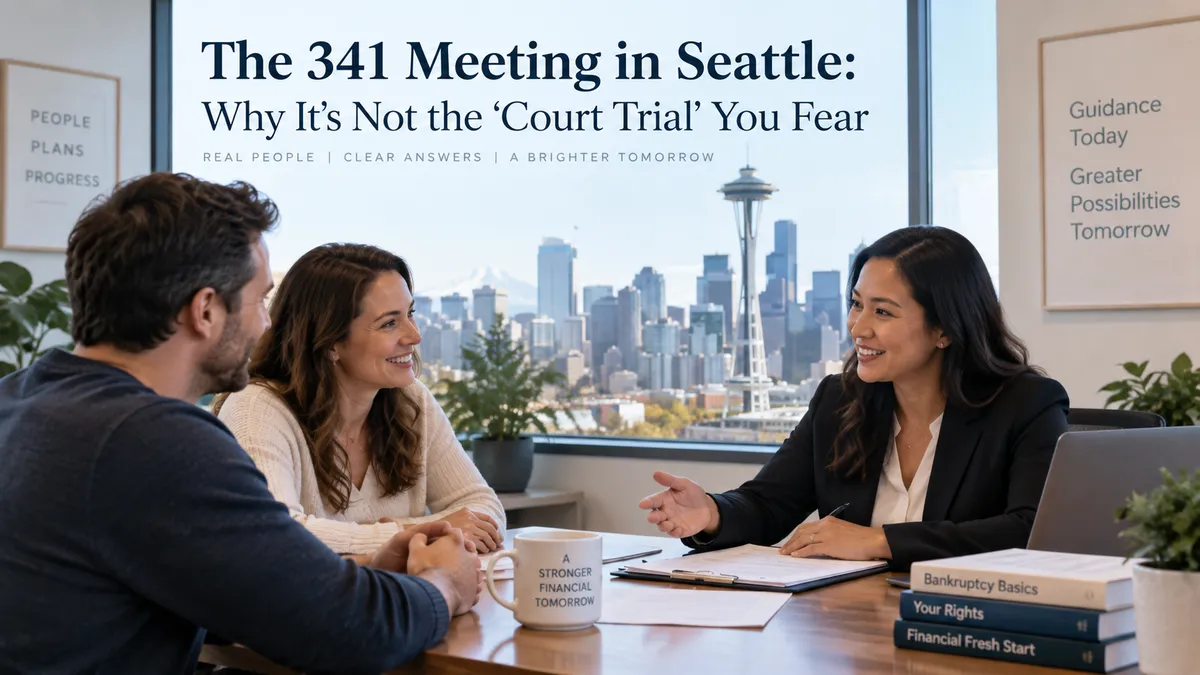
The 341 Meeting in Seattle: Why It’s Not the 'Court Trial' You Fear
A 341 meeting in Seattle is not a bankruptcy trial. You do not stand before a judge or argue your case in a courtroom.
Instead, a bankruptcy trustee asks questions under oath to confirm that your petition, assets, debts, income, and financial history are accurate.
Key Takeaways
• A bankruptcy trustee conducts the meeting, not a judge.
• Most Seattle-area Chapter 7 meetings take place by Zoom.
• Preparation means reviewing your paperwork and answering honestly.
What Happens at a 341 Meeting in Seattle?
The trustee confirms your identity and reviews the financial information in your bankruptcy case.
The meeting gets its name from Section 341 of the Bankruptcy Code. Creditors receive notice and may attend, although they often do not.
The Western District of Washington explains that debtors answer questions under oath about their property, debts, and financial condition. The court also notes that a typical meeting may last less than 10 minutes once questioning begins. (Western District of Washington Bankruptcy Court – 341 Meeting of Creditors)
Common questions include:
• Did you review your bankruptcy petition before signing it?
• Is the information accurate?
• Did you list everything you own?
• Did you list all creditors?
• Has your income or employment changed?
• Do you expect a tax refund or other money?
• Did you transfer property before filing?
• Does anyone owe you money?
• Do you have a lawsuit or legal claim?
The trustee may ask additional questions based on your finances.
For example, a Seattle homeowner may need to explain home value, mortgage balances, and equity.
A business owner may face questions about business income, property, or accounts.
The purpose is verification.
The trustee wants to determine whether your bankruptcy paperwork is complete and whether any assets may be available for creditors.
The 341 meeting is not where you prove that you deserve bankruptcy. It is where the trustee verifies the financial information disclosed in your case.
Why Is the 341 Meeting Not a Bankruptcy Court Trial?
A 341 meeting is an administrative examination, not a courtroom proceeding.
A bankruptcy judge does not conduct the meeting.
The U.S. Trustee Program explains that the trustee questions the debtor about assets, debts, income, expenses, and bankruptcy paperwork. Creditors may also ask relevant questions. (U.S. Trustee Program – Section 341 Meeting of Creditors)
You should not expect:
• A jury
• A judge questioning you
• Opening or closing arguments
• A decision about whether you are a good person
• A courtroom-style cross-examination in a routine case
You are under oath, so your answers still matter.
Answer truthfully and directly.
Do not guess when you do not know a number.
If you discover that something in your petition is wrong, tell your attorney. Bankruptcy filings can sometimes be amended when corrections are necessary.
A mistake is easier to address when disclosed promptly.
Trying to hide an asset, transfer, account, or source of income creates much greater risk.
If you are considering filing, reviewing your case with a Seattle Chapter 7 bankruptcy attorney before the meeting can help identify issues early.
How Should You Prepare for a Seattle 341 Meeting?
Preparation is usually straightforward.
Review your bankruptcy petition before the meeting and make sure you understand what was filed under your name.
Most Chapter 7, Chapter 12, and Chapter 13 341 meetings in Western Washington currently take place through Zoom. The bankruptcy court provides trustee-specific meeting information and instructions for submitting identification. (Western District of Washington Bankruptcy Court – Section 341(a) Meeting Information)
Before your meeting:
• Review your petition and schedules
• Have government-issued photo identification ready
• Provide proof of your Social Security number as instructed
• Keep requested financial documents nearby
• Check the Zoom information in your bankruptcy notice
• Test your camera, microphone, and internet connection
• Join from a quiet location
Do not use meeting information from another person's bankruptcy case.
Your trustee may have separate Zoom credentials.
You should also tell your attorney about important changes before the meeting.
Examples include:
• A new job
• A significant change in income
• An inheritance
• A large tax refund
• A new lawsuit or settlement
• Property you forgot to list
• A recent bank transfer or asset sale
Preparation does not mean memorizing scripted answers.
You only need to understand your own financial information and answer accurately.
Good 341 preparation is not about rehearsing perfect answers. It is about knowing your financial disclosures and answering the trustee accurately.
What Happens After the 341 Meeting?
The trustee may conclude the meeting, request more information, or continue it to another date.
A completed meeting does not mean the bankruptcy case ends immediately.
In a routine Chapter 7 case, the case continues through the remaining deadlines before discharge.
The U.S. Courts confirms that the trustee conducts the 341 examination and that bankruptcy judges do not attend these meetings. (U.S. Courts – Chapter 7 Bankruptcy Basics)
After the meeting, several things may happen.
The trustee closes the examination
If the trustee has no additional questions, you may not need another 341 appearance.
The trustee asks for documents
You may need to provide:
• Bank statements
• Pay records
• Tax documents
• Vehicle information
• Property valuations
• Mortgage balances
• Business records
A document request does not automatically mean your case has a serious problem.
The meeting is continued
The trustee may schedule another date if additional information is necessary.
Your case continues toward discharge
You still need to complete all bankruptcy requirements, including any required debtor education course.
You should also respond promptly to trustee requests and stay in contact with your attorney.
In many routine Chapter 7 cases, the 341 meeting may be the closest thing a debtor has to a formal appearance during the bankruptcy process.
FREQUENTLY ASKED QUESTIONS
Q: Do I have to appear before a bankruptcy judge at my Seattle 341 meeting?
A: No. A bankruptcy trustee conducts the 341 meeting. A judge does not preside over it. You answer questions under oath about your petition, assets, debts, income, and financial history. A creditor may attend and ask relevant questions, but the meeting itself is not a court trial.
Q: How long does a 341 meeting usually take?
A: The trustee's actual questioning in a routine case may be brief. Your total time online can be longer because several bankruptcy cases may be scheduled during the same Zoom session. Meetings may take longer when the trustee needs additional explanations or documents.
Q: What if I answer a question incorrectly?
A: Correct the mistake as soon as you realize it. Do not guess or continue with information you know is wrong. An honest error can often be addressed by explaining the correction to the trustee and your attorney. Intentionally hiding information creates much more serious problems.
Q: Can creditors attend my 341 meeting?
A: Yes. Creditors receive notice and have the right to attend and ask relevant questions. However, creditor participation does not turn the 341 meeting into a courtroom trial. Significant legal disputes generally require separate bankruptcy court procedures.
Ready to Prepare for Your Seattle Bankruptcy Meeting?
The 341 meeting can sound intimidating before you understand what actually happens.
For most Chapter 7 debtors, it is a short financial verification meeting rather than a courtroom confrontation.
The Law Firm of Howard Williams can help you review your bankruptcy paperwork, prepare for trustee questions, and identify potential issues before your meeting.
Contact the Law Firm of Howard Williams to discuss your Chapter 7 options and next steps.
About Howard Williams
Howard C. Williams is the founder of The Law Firm of Howard Williams in San Diego, California. He earned his J.D. from Western Sierra Law School and has been admitted to practice in California since 2009. His practice covers personal injury — auto, motorcycle, truck and rollover collisions — along with criminal defense and Chapter 7 bankruptcy. He is a member of the San Diego County Bar Association, Consumer Attorneys of San Diego, and the National Association of Consumer Bankruptcy Attorneys.
